Lately, I got interested in OT (Operational Technology). Big factories, nuclear plants, mines and production lines seems to be more interesting than next boring app with XXS's.
It's strange for me that there is such less resources about OT than IT. OT is much much more important nowadays.
Knowing fundamentals of IT security I feel that it is a good moment for me to transistion to OT and explore this big rabbit hole.
First thing I have to do is making of some kind of playground for my exploration - virtualized homelab.
Simultaneously this project will show that I know fundamentals of virtualization, OT networking and network devices programming - which are often seen in job requirements.
This is not a tutorial. It's just my writeup in diary-like style showing my journey, not final results. I assume that reader is not a total newbie and knows some stuff, like me.
After few web searches I know that basically I need minimum 4 virtual machines in my lab so as always I needed to start with making some free space on SSD disk.
Filesystem Size Used Avail Use% Mounted on
/dev/sda3 869G 779G 46G 95% /home
Filesystem Size Used Avail Use% Mounted on
/dev/sda3 869G 454G 372G 56% /home
More than enough, god bless additional HDDs
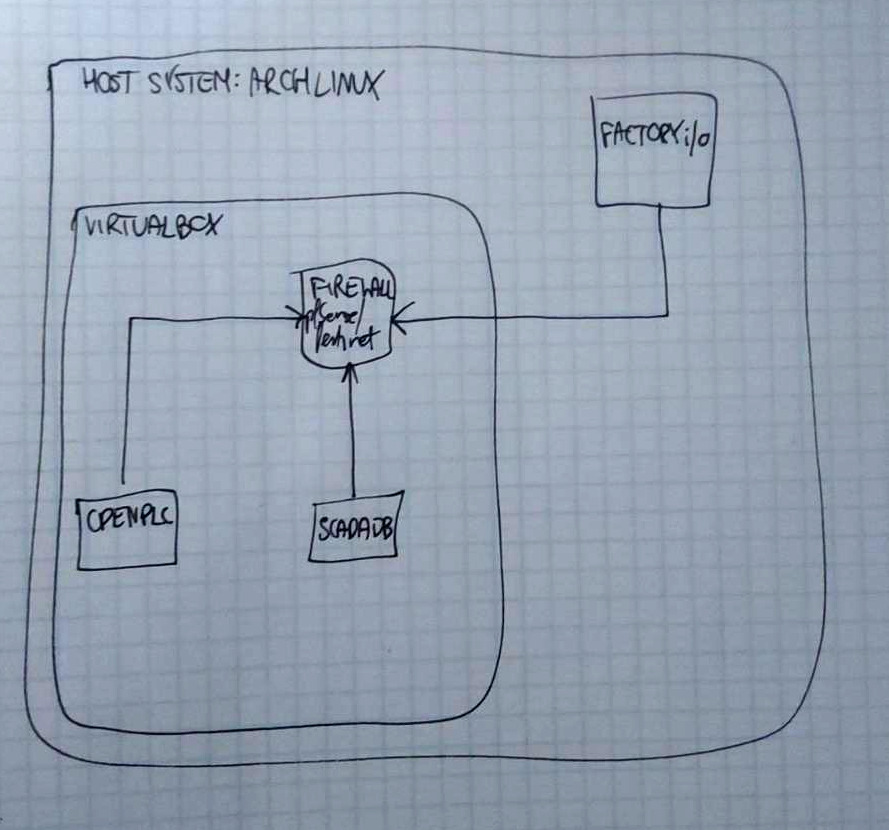
virtual lab diagram v. 1.0
Firewall - mr. Bouncer

vs

I have two options. FOSS pfSense and Fortinet's FortiGate. My heart says "pfSense" but let's break ideological comfort zone and let's try some properiatory software which probably I will see more often in real environments.
First I need to create some burner email to register for trial version of FortiGate (RED FLAG).
Ahh shiet. Change of plans. I was searching for any hints about istallation of FortiGate in VirtualBox when I came across mention of
GSN3. I didn't know about existence of that software.
I wish I know that earlier, but it's never too late to learn it.

Few lectures and webinars later...
Now I know what I can do with GNS3. For now, I am planning to seperate my virtual lab into two. First for practicing ICS attacks (simialar to one from diagram above) and second for practicing networking using CISCO switches and routers.
